CHAPTER 05
The Garden of Gethsemane
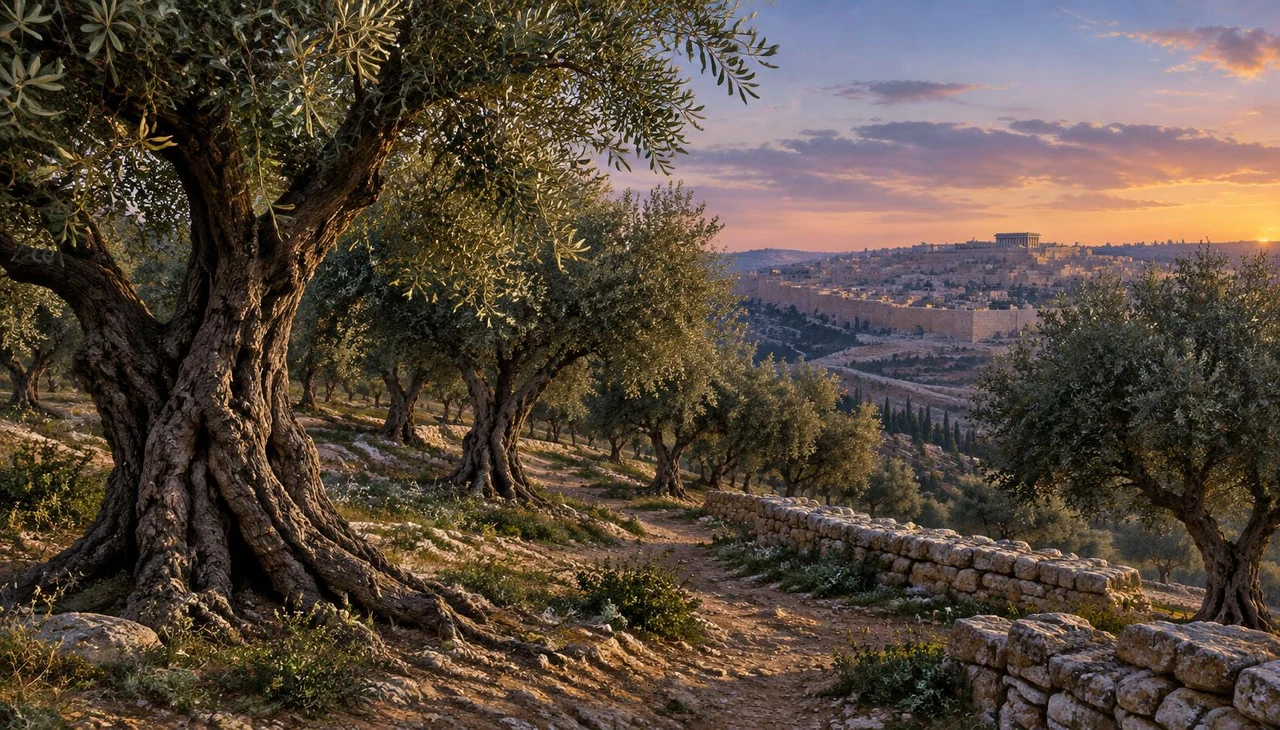
Artistic reconstruction · not an authenticated photograph or exact archaeological model.
Guest progress is saved for this browser session only. Sign in for private account saving.
Ancient geography
Jerusalem • hills & valleys
Gethsemane tradition
Traditional identification
The traditional garden near the Mount of Olives. This is not proof of the exact prayer or arrest spot.
31.7786° N · 35.2392° E · representative point
Geography sourceCoordinate-based schematic, not an archaeological survey. Valley/ridge lines are approximate; no reconstructed street route or first-century wall boundary is claimed. Pins distinguish geography, tradition and uncertainty.
The biblical account
Prepared narrative summary · not a Scripture quotation
After the meal, Jesus goes with his disciples to Gethsemane. Mark describes his distress, his prayer and his request that the disciples remain watchful. They repeatedly fall asleep. The passage holds vulnerability and obedience together, without minimizing the difficulty of the moment. John places the arrest beyond the Kidron Valley in a garden. The olive grove before you is an artistic landscape. It offers a quiet setting for reading, but does not identify the exact trees, garden boundaries or place where Jesus prayed.
Historical context
The Mount of Olives and Kidron Valley provide geographic orientation. Several places in the area are connected with Gethsemane by tradition; the precise prayer and arrest locations are not securely established.
Pause & Reflect
What does faithful presence mean when another person is distressed or exhausted?