CHAPTER 08
The Empty Tomb
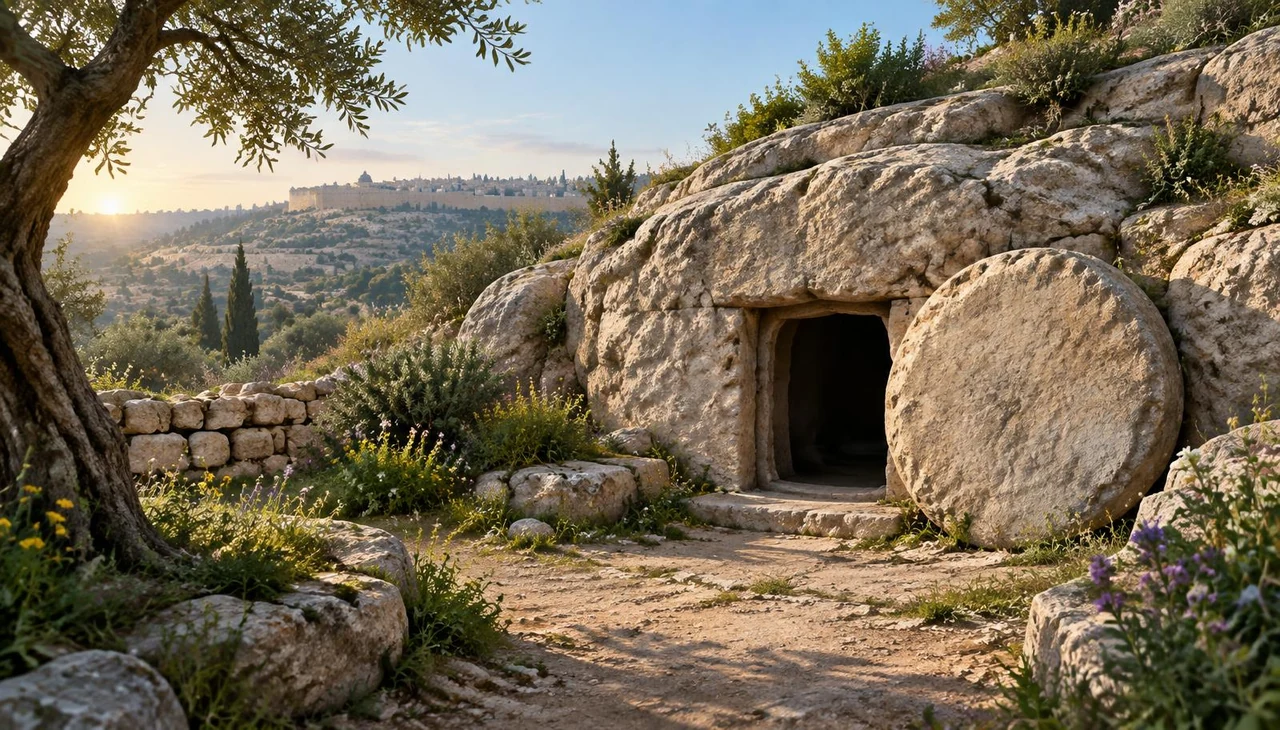
Artistic reconstruction · not an authenticated photograph or exact archaeological model.
Guest progress is saved for this browser session only. Sign in for private account saving.
Ancient geography
Jerusalem • hills & valleys
Golgotha & tomb tradition
Traditional identification
The Holy Sepulchre commemorates Jesus’ crucifixion and burial over an ancient quarry and burial area. Archaeological context does not prove the precise event locations.
31.7784° N · 35.2298° E · representative point
Geography sourceCoordinate-based schematic, not an archaeological survey. Valley/ridge lines are approximate; no reconstructed street route or first-century wall boundary is claimed. Pins distinguish geography, tradition and uncertainty.
The biblical account
Prepared narrative summary · not a Scripture quotation
Luke describes women arriving at the tomb on the first day of the week and finding the stone moved and Jesus' body absent. Their uncertainty meets a message that sends them back to the disciples. The disciples do not all receive the report in the same way. The account preserves surprise rather than making recognition seem effortless. This rock-cut tomb is an artistic illustration of a setting; it is not an image of a confirmed tomb belonging to Jesus. The empty-tomb narrative and the historical identification of a present-day site are different kinds of questions.
Historical context
The Holy Sepulchre has been associated with Jesus' tomb since antiquity. The Garden Tomb is a later alternative devotional identification. Neither this artwork nor a tradition establishes the depicted entrance as the exact Gospel tomb.
Pause & Reflect
How does this passage portray the first responses to unexpected news?